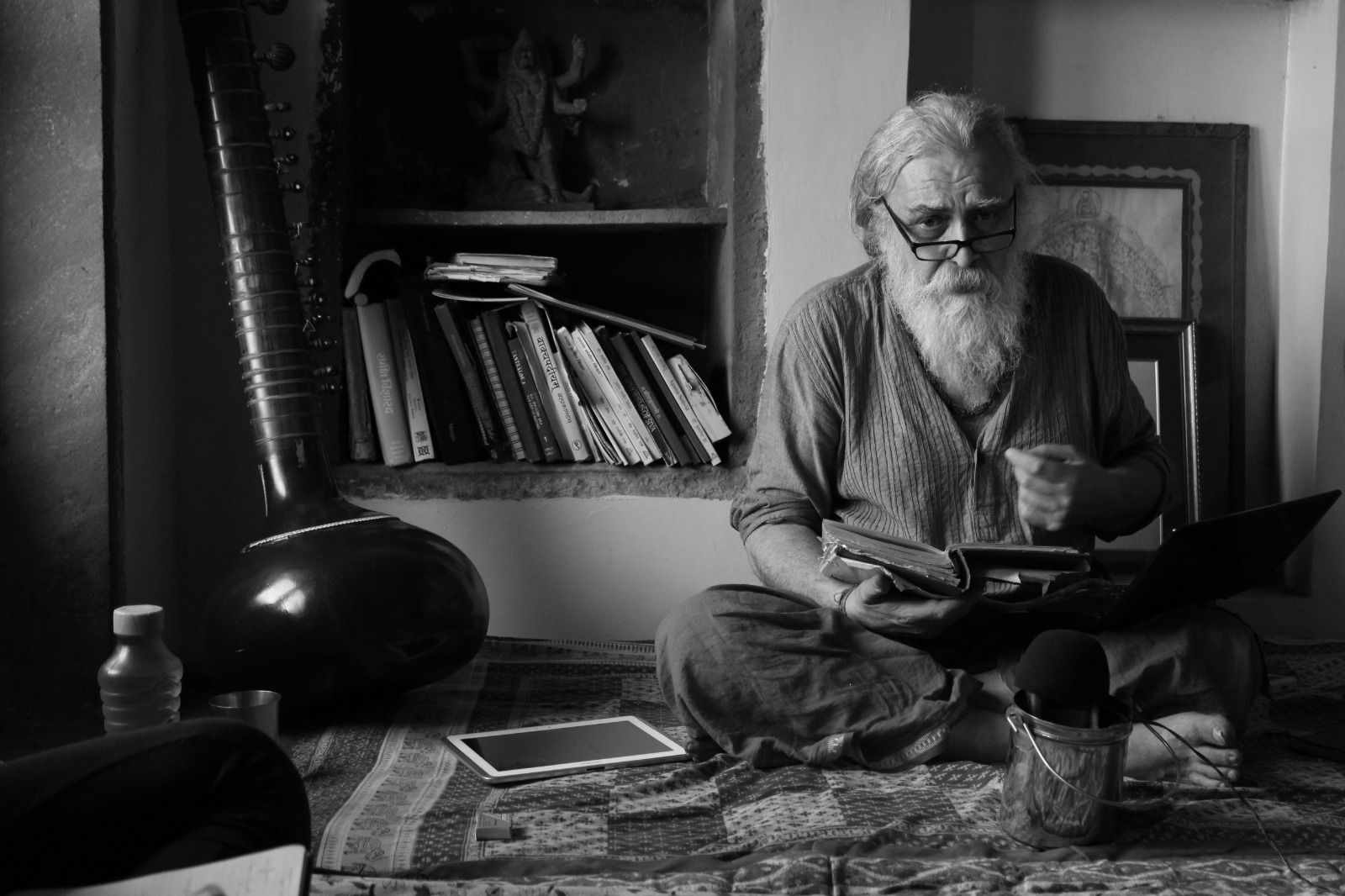


Welcome to the Tantrāloka Home Study Program course on Tantrāloka Chapter Thirteen.

 This course covers the verses of thirteenth chapter of Abhinavagupta’s Tantrāloka.
Chapter Thirteen is part of Volume Seven – Chapters Eleven through Fourteen.
In chapter thirteen Abhinava goes on talk about Śiva’s grace in accord with the teachings of his Trika master Śambhunātha. He deals with the basic concepts and problems regarding the descent Śiva’s power of grace (śaktipāta). The highest grace is the liberation attained by the realization of one’s own unconditioned Śiva nature as the ultimate nature and source of all things. This takes place when Karma comes to an end. Abhinava tackles the main questions in relation to this doctrine to establish that Śiva is free to grace whoever he chooses whenever he likes. Although he agrees with the Siddhāntin that the occasion for this purifying grace is initiation, he refutes his view that it takes place when the postulant’s good and bad Karmas balance out or binding impurity ‘matures’ enough to be removed. If the occasions for grace where to be such, Śiva would be constrained to wait for them to arise. This, Abhinava points out, would imply that he is not free to act as he wishes and would be as constrained by causes and conditions as is any fettered soul. For Śiva to be Śiva, that is, free, complete and unconditioned, he cannot be confronted with some other alien reality that could limit him. Thus, ultimately, we must admit that it is Śiva who both illumines and obscures himself
For the background on this text and its relationship to the larger topic of Kashmir Shaivism, please see the Program Overview on this site. You may also like to listen to the free course on Locating Trika, which provides historical overview.
Overview of Chapter Thirteen:
Lesson 1
The superiority of Śaivism with respect to the sāṃkhya and other schools (verse 1–13ab) – part 1
The superiority of Śaivism with respect to the sāṃkhya and other schools (verse 1–13ab) – part 2
The superiority of Śaivism with respect to the sāṃkhya and other schools (verse 1–13ab) – part 3
The nature of ignorance (verse 14–31)
Lesson 2
The existence of ignorance cannot be explained (verse 41cd–107)
Śiva out of his own free will binds and liberates himself (verse 103–108) – part 1
Śiva out of his own free will binds and liberates himself (verse 109–111ab) – part 2
Śiva’s grace is independent of māyā, karma or impurity (verse 110–115)
Śiva is the cause of grace and freely manifests the degrees of grace (verse 116–128)
The varieties of the descent of the power of grace (śaktipātavicitratā) (verse 129–132ab)
Lesson 3
The teacher and disciple (verse 132cd–133) – part 1
The teacher and disciple (verse 133) – part 2
The stabilization of unsteady understanding, direct initiation by the goddess and self purification (verse 133–145)
Pratibhā, intelligence and imagination, a teacher is required for kāmya rites (verse 146–149)
According to the trīśikāśāstra spontaneous (sāṃsiddhika) (verse 149–154)
Intuition (pratibhā) is the supreme means to realization (verse 155–167ab)
Lesson 4
Discrimination (viveka) bestows knowledge born of intuition (prātibha) (verse 167cd–182)
The teacher’s instruction is a source of intuitive knowledge (verse 173–183)
The lower form of mind and intellect is binding (verse 183–191) – part 1
The lower form of mind and intellect is binding (verse 184–192) – part 2
Lesson 5
Immediate realization and other fruits of varying degrees of grace (verse 193–208) – part 1
Immediate realization and other fruits of varying degrees of grace (verse 208) – part 2
The intense descents of the power of grace (verse 209–224ab) – part 1
The intense descents of the power of grace (verse 224cd–230) – part 2
The intense descents of the power of grace (verse 224cd–240) – part 3
The moderate and mild descents of the power of grace (verse 240cd–265)
The lord obscures himself by the craving of the soul (verse 266–292ab)
No specific time and cause of grace, four grades of initiates according to the intensity of grace (verse 292cd–300ab)
Lesson 6
The hierarchy of Śaiva scriptures and traditions, true and false teachers (verse 300cd–314ab)
The teacher to adopt, the value of learning from many teachers (verse 314cd–361)
Information on content and pricing:
| Content | Price | Buy | |
|---|---|---|---|
| Tantrāloka Chapter XIII | 30 recordings, 6 lessons | $150 |  |
Course materials:
- PDF verses of Chapter 13, translated by Dr. Mark Dyczkowski, printed in the original Sanskrit (both Devanagari script and transliterated to English), and English translation.
- Streaming audio and videos of Dr. Dyczkowski teachings.
- Email support: If you have questions of a more personal or individualized nature, concerns about the course, or complex intellectual questions that go beyond the scope of the course, please email info@anuttaratrikakula.org, and we will respond to your question confidentially and appropriately.
- Use of materials: If you would like to use any of Dr. Dyczkowski’s recordings or course materials in your own classes, presentations, or live teachings, please contact us at info@anuttaratrikakula.org. We are happy to support this and will work with you to find the most appropriate way to share.
We hope you will enjoy the course and that you will join us for more as we go forward.
OM SAUḤ PARĀYAI NAMAḤ