Drinking The Nectar of Tantrāloka

Tantrāloka is a dream come true, a cave of gems, a wish-fulfilling cow.  For a thirsty seeker after truth who is mad with love for Lord Shiva and his magnificent Śakti shining as this world, this is Lake Manassarovar.  How foolish not to take a dip, to drink deeply of this draught that has been proffered by one of the greatest spiritual minds of all time.  This exquisite palace of gems, illuminating every corner of Hindu philosophy with overwhelming light, dripping with the rasa of the bliss of full awareness, and pulsating with radiant love, has been hidden for a thousand years.  Somehow at this moment, after decades of toil and devotion by a great and humble soul, we have the amazing good fortune to hear and try to understand the sublime Ācārya Abhinavagupta’s teachings in our own language, conveniently in our own home, any time we wish, simply by pushing a few buttons on a screen.  What miracle is this!

Tantrāloka in 37 comprehensive chapters teaches the entire path of true devotion, recognition, and self-knowledge.  It instructs in the highest truth and offers direct guidance on how to attain self-realization through a multitude of paths, from which one can choose the most suitable.  From the structure of the universe to esoteric breathing practices, elaborate explanations of the Wheel of Time (Kālacakra), rapturous eulogies of the Divine Mother, profound and secret practices of visualization and meditation, complete instructions regarding initiations and ritual, the entire corpus of tantric mantras, enlightened reworking of Vedanta, Samkhya, and Shaiva Siddhanta philosophical schemes, married to the wild view of the Bhairava tantras; masterful explanations of kundalini, nadis, cakras, and all the magical path of “piercing,” to the truly thrilling mystical emanation of the cosmos through the energies of the Sanskrit alphabet; this is a work beyond any ever written in the field of yoga, tantra, and spirituality.

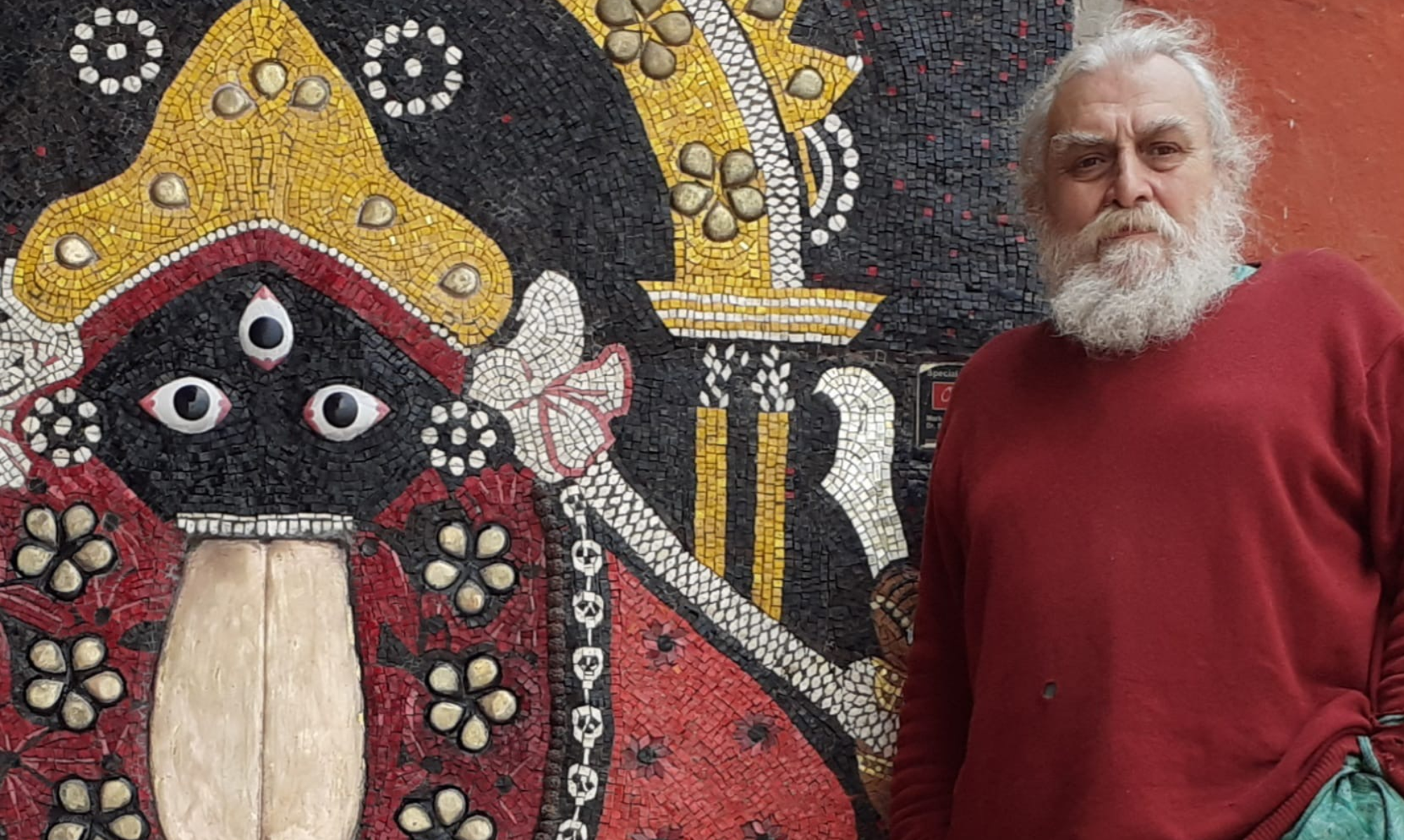
After 35 years and countless lifetimes of wandering and searching, like a scorched traveler in the desert of samsara, I arrive weeping tears of gratitude for the amrita of Abhinava’s profound teaching.  I touch the feet of Sadaashaya, Dr. Mark Dyckzowski, by whose selfless, uncompromising sacrifice this cup is now offered to the world.  I invite everyone who shares this thirst to join the Anuttara Trika Kula and enjoy the fruit of this toil.  This gift is being offered to each and every one of you as Lord Shiva and Śri Parā Devī, so that you may enjoy the marvelous play of awakening to your own unbounded, perfect, blissful nature.  Won’t you join us for this feast?

For more on how to participate in the Tantrāloka Home Study Program, please visit https://www.anuttaratrikakula.org/tantralokaoverview/.   To preregister for the first FREE lesson on Verse One, the opening of Tantrāloka, please email us at info@anuttaratrikakula.org.  We look forward to sharing this adventure together with you.


OM SAUḤ PARĀYAI NAMAḤ

Locating Trika, Locating Oneself

The release of the first modules of guided teachings on the philosophies of Kashmir Śaivism signals a new beginning for our Kula.  New beginnings are times when it is important to recall fundamentals and reaffirm commitments.  This is especially true, perhaps, for the worlds of the Tantras, in which– as Mark reminds us in the first lecture– immense dimensions of tremendous beauty and profound inspiration are to be realized.  It can be tempting to lose oneself amid such splendors and to forget that both the purpose and fundamental teaching of the Tradition are actually very simple.  But, as someone once said in another context, the simplest things are always the most difficult.

 The purpose of the Tradition is to achieve liberation.  “Liberation from what?” you may ask. The best answer to that question is another one: “Well, what have you got? What is it that seems to limit or constrain you?”  Whatever that is, liberation means liberation from that. Do you feel constrained by the round of birth and death?  Then liberation is liberation from the round of birth and death.  Do you feel constrained by poverty or illness? Then liberation is liberation from poverty or illness.  Do you feel constrained by grief over suffering or by fear for the future of humanity on this planet? Then liberation is liberation from these things. Do you feel constrained by the Lord Śiva? Then liberation is liberation from the Lord Śiva. For in point of fact the Lord Śiva is Himself constantly seeking to free Himself from Himself.  And since He is the Lord Śiva He is constantly succeeding.  The means of his success is his power, that is, the absolute freedom and autonomy of the Goddess, his Consort.  And you yourself – you living your individual life — are the result of His success, along with everything else that does or can exist.  For every element and aspect of the entire manifest universe is nothing more or less than the expression of the Lord’s absolute freedom—even and perhaps especially his freedom from Himself.  That, after all, is what “absolute freedom” means: that, or nothing.

The Masters of the Tradition began with a single simple insight:  no matter what the object of their awareness, it is always accompanied by that awareness itself.  Awareness is always self-aware.  But then they noticed something else, something equally simple and obvious.  The objects of their awareness, whether internal to themselves or external in the world, did not seem to share in this self-awareness.  But this is rather puzzling.  Because whenever we become aware of anything, we become one with it in the very act of knowing it.  But how is it possible for two things of such fundamentally different nature to become so unified?  How is it possible for awareness to become one with lack of awareness in the act of knowing? Pondering deeply, the Masters came to their remarkable, even stunning, conclusion: it is simply not possible for this to occur.  Therefore that must not be what in fact does occur.  Rather, what must occur in the act of knowing is that self-awareness becomes one with self-awareness.  Everything must be self-aware.  Everything must be Consciousness.  Moreover, there must be only one such Consciousness, because if there were really two, each of them would be separate from the other’s awareness in the act of knowing and that is just what has been shown to be impossible.  But this is perhaps even more puzzling.  For if everything is in fact one Consciousness, how is it that it appears as many and insentient?  Working out the answer to this question and actually experiencing that answer –along with all of its quite extraordinary ramifications–is the essence of the Tradition itself.

Abhinavagupta’s Dehastha Devata Chakra Stotram

This is a two part blog (second one follows right below) on residing divinities praised by Abhinava in his Dehastha Devata Chakra Stotra or “The Goddess Within, Hymns to the Divine Mother”.

In this unique stotram, Abhinava explicitly indicates that the human body is of divine origin and should be worshipped as the location of pithas (seats) where various divinities reside. With moving poetics, he indicates how these various deities are constantly offering obeisance to the presiding deity, the heart or hrdaya represented by Ananda Bhairava with his consort Devi, the guru, and two gatekeepers: Ganapati and Vatukanatha. According to Abhinava, the human body is not to be rejected but to be revered as residing place of wonderful deities who can be felt and experienced. This occurs subtly at first, but becomes more established with regular attention and practice.

We’d like to share the original stotra in this post which we suggest that seekers read and reflect.

Perspectives on Abhinavagupta’s Dehastha Devata Chakra Stotram

Abhinava’s intended message embedded in this poem is this – Everything is consciousness which is ever engaged in perception, awareness and action. He encourages us to cultivate our body and its sensual apparatus so that it tunes our anthakaranas (i.e. Mind, Intellect and Ego) to see the wonder of yoga. Every act of perception, small or big presents us an opportunity to experience the sweet bliss of the lord. Wouldn’t we want to choose carefully and use the opportunity in the right manner so we commune with the lord?

Verse 1: is ascribed to Ganapati – traditionally a smarta practice ascribed to the remover of obstacles but more deeply, Ganapati is represented both as a gatekeeper and as prana. Using the power of poetic suggestion, Abhinava explains that human body being a temple, requests Ganapati to grant entry. Note the beautiful double-entendre here – in one way, Ganapati is the pati of bhuta ganas but more subtly he is the master of all the pithas (hosts) in the body.

Verse 2: is ascribed to Vatuka (Vatukanatha) – he is the incoming breadth, the apana vayu which is also a gatekeeper. As we are about to engage with the deities residing in our body, we also pray that the worship bears fruit. Subtly put, “knots and doubts of the mind” indicates doubts that arise during the process of worship and we pray Vatuka to protect us from such doubts.

From the first and second verse, it is explicit that the whole human body is supported by the two primal life-currents, the prana and apana. They hold the human body together and Ganapati and Vatuka are the hosts.  Having paid attention to the gatekeepers, Abhinava draws us into the temple of our body.

Verse 3: is ascribed to the supreme presiding deity ananda-bhairava – who is wonderfully situated in the center of the heart as chakreshvara. The poet connects the prana and apana from previous verses directly to heart, who is ananda bhairava or ever blissful. Why? Because, the goddesses of indriyas (Karmendriyas and Jnanendriyas) surrounding him are constantly worshiping him with things pleasing to the senses. Whatever happens in the body, whatever we do to our body, good or bad, the goddesses render them into beautiful things for Bhairava. This Bhairava situated in the core of our being is of nature “chinmayam”, the supreme consciousness. The stress here is that our core being is ever blissful and contains supreme godhead just like it is said in the Vedas and Upanishads. In this stotram, the heart-center is portrayed as Bhairava as opposed to the classical para Siva because he is aghora i.e. power and grace that raises and liberates (Udyamo Bhairava – Siva Sutras). As such he is transcendental and above human plane of existence still residing in the core.

Verse 4: is ascribed to the Guru as the giver of the grace in the previous verse. Guru is prayed here for the intellectual strength by which we can approach pleasure, pain and sorrow to be pathways to Siva. This “intellectual” strength is not mere aspect of some intelligence or brain power. This is what is referred to as “Suddha Vidya” or the rise of true knowledge which happens after long loving approach to life.

Verse 5: is ascribed to Ananda Bhairavi as the consort of Ananda Bhairava – The devi is Aham Vimarsa or the supreme energy of awareness. As such she is no different from Siva (the classic explanation is that the heat or energy of fire is no different from the fire itself) and represents the Svantantrya Shakthi. All the sense data and experience is nothing different from Siva but is identical to him. She is the aggregate of all the awareness and is filled with that bliss. She resides in the core of our being, the hrdaya in perfect union.

The lotus of the heart has eight petals and so now the stotram proceeds to each petal pointing to different directions.

Verses 6 through 13 – Each of the directional deities represents buddhi, ahamkara, manas and the five tanmatras respectively. One cannot but connote the association of these eight principles to puryastaka, the baggage that is packaged up during transmigration. Abhinava deftly indicates that the human body is essentially organs of the lord and that by having the right bhavana, right attitude, our body-mind apparatus can be attuned to the saving grace of Siva and be liberated from transmigration.

Verse 14: he situates Atma very beautifully with several dimensions – as the Kshetrapala who protects the body, as the ever pervading aura of the body, as the content of six systems of philosophy, as the sum total embodiment of all the 36 principles. So who is this Atma the integral of everything? It is none other than consciousness itself (Chaitanyam Atma – Siva Sutra). Abhinava’s genius of suggestion is evident here. As Kshetrapala, he both protects and watches the plethora of activities of the pinda – a tantric parallel to the two birds of the Upanishads – without ever mentioning Advaita, monism etc. As a master poet, he leaves it to the imaginations of the experient.

Sources:

  • The Goddess within, Hymns to the Divine Mother – http://abhinavagupta.net/hymns1.05.html
  • Workshop on Tantraloka Chapter 1, Dr. Mark  Dyczkowski, Berkeley August 2012
  • Lecture on the 12 Kalis, Dr. Mark Dyczkowski, Berkeley June 2010
  • Abhinavagupta, An historical and philosophical study, Dr. K.C. Pandey
  • Śaivism and the tantric traditions, Dr. Alexis Sanderson
  • The Triadic Heart of Śiva, Kaula Tantricism of Abhinavagupta in the Non-Dual Shaivism of Kashmir; Paul Eduardo Muller-Ortega

Varanasi Nov 17th; Abhinava and Music

First and foremost, an announcement: Tantraloka Studies with Dr. Mark Dyczkowski is scheduled to start on 17th November on Karthik Purnima. The 10 day program will include two day outing to sacred Vindhyachal and Pancakrosha. We will also have a chance to listen to wonderful Sitar music by Mark to reinforce the teachings :). Now on to the blog..

“A very quick absorption is attained in a flash during the sound of this tune, because, being so close to pure Consciousness, it is quite akin to it” -Tantraloka, 3.239*

Masters of Tantric schools advocated a spiritual path that combined “bhukti” (attainment of enjoyment) and “mukti” (attainment of liberation). They considered both of them as objectives of human life.

Even before Shaivism and Shaktism, aesthetically pleasing elements were presented as aids to spiritual development in other branches as well. Song and dance were part of pre-vedic cultures and the melodic Samaveda is well known to all. Yajnavalkyasmriti considered the music of vina to be a powerful aid in realizing the highest truth.  In the Vijyanabhairava, the pleasure aroused by song and music is accepted as a means to enter into the state of pure and blissful consciousness.

While Abhinava’s explanation of music and other objects pleasing to the senses in the context of self-realization will be a topic of a future blog, we know from Madhuraja that Abhinava sported a Vina by his side and played it occasionally. In this post, we present you a short bhajan by Dr. Dyczkowski to go with your Sadhana. Enjoy.

** Blog content adapted from “Specific Principles of Kashmir Shaivism” by B.N. Pandit.

And so we begin…

Watching the Russian movie Solaris is a thrilling experience with Stanislaw Lem expounding the limits of ultimate inadequacy of communication between humans and other species. Well, this was my initial personal experience with Kashmir Shaivism 7 years ago – the focus on locating the supra-reality in our daily experiences seemed ineffable at best, both intellectually and ritually.

Then I stumbled upon the works of Dr. Mark Dyczkowski. After several years, this has turned into a directed personal journey. A journey for me and fellow seekers where the teachings of the Trika Tantras continue to plumb the depths of our mundane transactional experience to that of the Anuttara, that ineffable oneness.

With deep respect, pranams and gratitude to that one reality, we embark on this Kula, on this nectar filled full moon Poornima day.

In this sister site of www.anuttaratrikakula.org,  we will attempt to make his works more widely accessible and available to aspirants of all levels. Many introductory and advanced articles, blog posts, audios, videos and music will be made available to spiritual seekers and scholars alike.

We welcome suggestions, ideas and collaborations from fellow seekers in this journey. Please feel free to contact us.